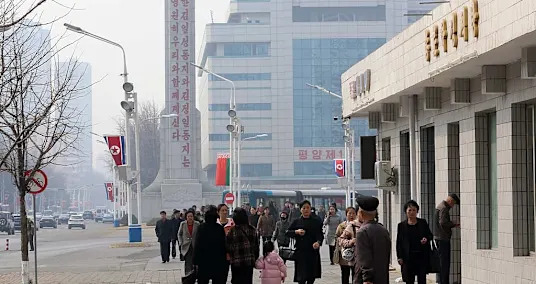
China has announced that its flag carrier, Air China, will resume direct flights to North Korea after a six-year pause, following the restoration of passenger train services between Beijing and Pyongyang.
This marks a significant step toward reopening North Korea, one of the world's most isolated nations, to the world.
Transport links between the two capitals had been suspended since the start of the Covid-19 pandemic in 2020, when Pyongyang implemented a very strict border closure.
While North Korean carrier Air Koryo already resumed flights to Beijing in 2023 and allowed Russian tour groups to visit in 2024, the return of China's air and railways are seen as a major economic milestone, as China has for decades been the main trading partner and a key source of diplomatic and economic backing for the country of 26 million people.
Before the pandemic, there were an estimated 300,000 foreign visitors in 2019, according to South Korea's Institute for International Economic Policy, and Chinese visitors accounted for 90% of all tourists to North Korea. Therefore, the long delay in resuming regular travel had surprised many regional observers.
"The reopening of these borders has been driven primarily by Pyongyang's timeline, which challenges the outdated assumption that Beijing dictates terms to a dependent client state," Seong-Hyon Lee, a visiting scholar at the Harvard University Asia Centre, explains.
Related
Nuclear ambitions complicated the relationship
Despite being Pyongyang’s primary ally, Beijing has frequently voiced disapproval over the North's persistent missile tests and nuclear ambitions. This aspect created a bumpy relationship with Pyongyang, with analysts saying that a nuclear-armed North Korea has often been something of a liability.
The diplomatic normalisation was highlighted last September, when Kim Jong Un attended a massive military parade in Beijing alongside Russian President Vladimir Putin. This was Kim's first appearance at a Chinese military display.
Lim Eul-chul, a North Korea expert at South Korea's Kyungnam University, argues that the war in Iran, in particular, increased "the need for closer coordination between the two nations".
LATEST POSTS
- 1
 Opening Monetary Information: Your Exhaustive Manual for Finding out about Individual budget
- 2Instructions to Improve Your Mental Exploration with Cutting edge Measurements
- 3Picking the Right Home Machines: A Commonsense Aide
- 4Air travelers face higher ticket prices as Iran war drives up oil prices
- 5Here's how 'Bridgerton' fans can watch the first episode of Season 4 before its Netflix release later this month




- Senior's Manual for Obtaining a Hyundai Ioniq EV: Tips
- Can scientists detect life without knowing what it looks like? Research using machine learning offers a new way
- Shelby County deputies charged with assault, placed on leave
- German finance minister sees advantages of smartphones in schools
- Birds at a college changed beak shapes during the pandemic. It might be a case of rapid evolution
- See the metal guts of a satellite in this wild X-ray view | Space photo of the day for Dec. 4, 2025
- Minneapolis ICE shooting live updates: Protests continue over agent's killing of Renee Nicole Good; Walz puts National Guard on standby
- Famous Versatile Brands: Your Decision
- Top 20 Style Brands for Pioneers