When you buy through links on our articles, Future and its syndication partners may earn a commission.

The parallels between the Artemis 2 and Apollo 8 moon missions now include a stirring holiday message.
As they circled the moon on Dec. 24, 1968, the three Apollo 8 astronauts read the first 10 verses of the Book of Genesis during a live TV broadcast that reached an estimated 25% of Earth's population.
Mission commander Frank Borman wrapped up the reading with these words: "And from the crew of Apollo 8, we close with good night, good luck, a Merry Christmas, and God bless all of you, all of you on the good Earth."

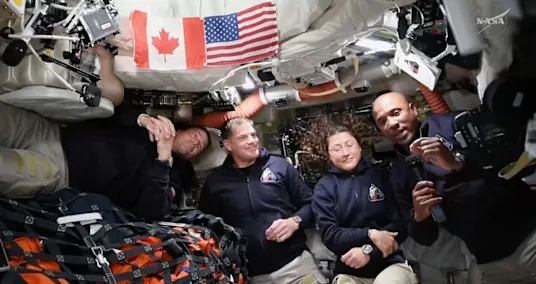
On Saturday (April 4), as Artemis 2's Orion capsule sped toward the moon, a CBS News reporter asked mission pilot Victor Glover if he wished to share any Easter thoughts with those of us here on Earth.
"I don't have anything prepared. I'm glad you brought it up, though; I think these observances are important," Glover responded.
Then he gave us some words that showed how thoughtful and eloquent he is, and how well he can think on his feet.
"You guys are talking to us because we're in a spaceship really far from Earth, but you're on a spaceship called Earth that was created to give us a place to live in the universe," Glover said. "Maybe the distance we are from you makes you think what we're doing is special, but we're the same distance from you. And I'm trying to tell you — just trust me — you are special."
Glover invoked God and the Bible in his impromptu address, but he took pains to reach believers and non-believers alike
"In all of this emptiness — this is a whole bunch of nothing, this thing we call the universe — you have this oasis, this beautiful place that we get to exist together," he said of Earth. "I think, as we go into Easter Sunday, thinking about all the cultures all around the world, whether you celebrate it or not, whether you believe in God or not, this is an opportunity for us to remember where we are, who we are, and that we are the same thing, and that we've gotta get through this together."
Apollo 8 and Artemis 2 are the first missions of their respective programs (Apollo and Artemis) to send people to the moon. (In fact, Apollo 8 was the first human spaceflight mission ever to go beyond Earth orbit.)
Like Apollo 8, Artemis 2 will not land on the lunar surface; rather, it will loop around the moon's far side, a milestone that will occur on Monday evening (April 6). That flyby will slingshot Artemis 2's Orion — which holds Glover, fellow NASA astronauts Reid Wiseman and Christina Koch and Canada's Jeremy Hansen — back to Earth, where it will arrive on Friday (April 10).
On the same day that Apollo 8 delivered its Christmas Eve message, lunar module pilot Bill Anders snapped one of the most iconic photos ever taken — the famous "Earthrise" shot, which showed our gorgeous planet hanging over the moon's desolate gray dirt.
The Artemis 2 astronauts will try to recreate that photo during their lunar flyby on Monday. And hopefully the image will have similar effects to the original, which has been credited with helping to inspire the environmental movement and drawing all of us on this fractured world just a little closer together.
LATEST POSTS
- 1
 I took my shoes off and went for a barefoot hike. I couldn’t believe what happened next
- 2Warning for snow and ice extended
- 3NASA funds new tech for upcoming 'Super Hubble' to search for alien life: 'We intend to move with urgency'
- 4The Secret Destinations Amex Says Will Be More Popular Than Bali by 2026
- 5Carrefour becomes first European retailer to offer shopping on ChatGPT



- India’s delayed climate plan sets modest emission target
- From record warming to rusting rivers, 2025 Arctic Report Card shows a region transforming faster than expected
- Step by step instructions to Boost the Eco-friendliness of Your Smash 1500.
- Thyssenkrupp to suspend electrical steel production at French site
- This Week In Space podcast: Episode 189 — Privatizing Orbit
- Doctor's orders: Eat ice cream, and other tips for a long and healthy life
- Vote In favor of Your Favored Kind Of Cheddar
- Treasure trove found in Egyptian tomb solves ancient mystery
- Modern surgery began with saws and iron hands – how amputation transformed the body in the Renaissance