When you buy through links on our articles, Future and its syndication partners may earn a commission.

For the first time in more than 50 years, humans are cruising through lunar space.
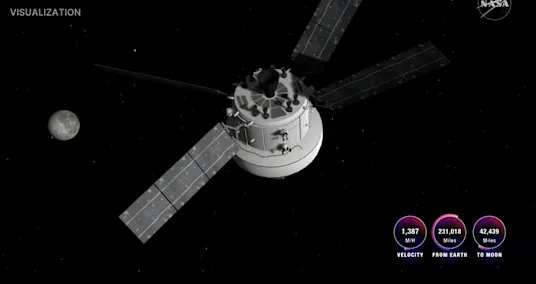
The four astronauts of NASA's Artemis 2 mission arrived in the moon's sphere of influence — the region where lunar gravity exerts a more powerful pull than that of Earth — today (April 6) at 12:37 a.m. EDT (0437 GMT).
The milestone occurred when the mission's Orion capsule was about 39,000 miles (62,764 kilometers) from the moon and roughly 232,000 miles (373,368 km) from Earth, a commentator said during NASA's Artemis 2 livestream.
The Artemis 2 astronauts — NASA's Reid Wiseman, Victor Glover and Christina Koch and the Canadian Space Agency's Jeremy Hansen — are the first people to cross the lunar threshold since December 1972, when the three-person Apollo 17 moon-landing mission did so.
Artemis 2 will not touch down on the moon, or even enter lunar orbit. Rather, Orion will loop around the moon's far side this evening in a history-making flyby. During that encounter, Artemis 2 will get farther from Earth than any crewed flight ever has.
The distance record is currently held by the Apollo 13 astronauts, who got 248,655 miles (400,171 km) from our planet in April 1970. At the height of tonight's flyby, just after 7 p.m. EDT (2300 GMT), Artemis 2 will be 252,757 miles (406,773 km) away from the rest of humanity, NASA officials have said.
The Artemis 2 astronauts will study the moon during the flyby, gathering data that could help scientists better understand the terrain and geology of Earth's nearest neighbor. They'll also be treated to a total solar eclipse, which will not be visible to those of us here on terra firma.
In addition, the flyby will chart their path home: Lunar gravity will slingshot Orion back toward Earth. Artemis 2 astronauts will come home on Friday (April 10), ending their 10-day mission with a parachute-aided splashdown off the coast of San Diego.
Editor's note: This story was updated at 1:15 a.m. EDT on April 6 with NASA's revised time of Orion's entry into the moon's sphere of influence — 12:37 a.m. EDT rather than 12:41 a.m. EDT.
LATEST POSTS
- 1
 Pain at the pump for Hampton Roads residents
 - 2Step by step instructions to Advance the Eco-friendliness of Your Kona SUV
- 3Ukrainian troops showed 'greater tactical imagination' than Western trainers, British officer says, pointing to their ambush tactics
- 4Iran Used $2 Billion in Crypto to Run Its Militant Proxies in 2025
- 5Europe: 4 Urban communities for a Paramount Social Experience





- Gov’t approves millions for border cities in North under Hezbollah fire
- France, Germany, Italy summon Iranian envoys over 'unbearable, inhumane' regime crackdown
- Deadly Switzerland ski resort fire was likely started by sparklers attached to champagne bottles, officials say
- 4 Jeep Models: Dominating Execution and Flexibility for Each Experience
- Best Quest for new employment Site for You to Track down Amazing open doors
- Cyber Monday streaming deals 2025: Grab the Disney+ Hulu bundle for only $5 and save over 60%
- A new mom skipped a routine appointment. An infected cut led to a devastating diagnosis
- How on earth did 'Shark Tank' star Kevin O'Leary end up in 'Marty Supreme'? I'll let him explain.
- Volunteers aiding humpback whale stranded in Baltic get death threats