When you buy through links on our articles, Future and its syndication partners may earn a commission.

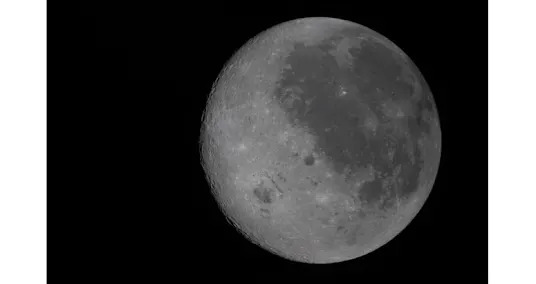
The Artemis 2 astronaut mission is giving humans an up-close and personal look at the moon.
That eye-full view had not been possible since NASA's Apollo 17 astronauts departed the moon back in 1972, now over 50 years ago!
Scientists have plotted out a lunar observation campaign for the Artemis 2 crew, for the astronauts will be the first humans to survey certain areas of the moon's far side as they conduct their flyby today (April 6).
Naked-eye observations
Artemis 2 is sending four astronauts — NASA's Christina Koch, Reid Wiseman and Victor Glover, and the Canadian Space Agency's Jeremy Hansen — on a 10-day trip around the moon in an Orion capsule. The mission launched atop a Space Launch System rocket on April 1.
During the trip, the quartet are capturing images, making observations and detailing their views via crew tablets and crew-to-Earth communications, said Kelsey Young, the Artemis 2 lunar science lead at NASA's Goddard Space Flight Center in Maryland.
"The camera being used is a Nikon D5 Digital Single Lens Reflex camera with an 80-400 millimeter lens. Additionally, the crew will be making audio observations with both the naked eye and through the zoom lens," Young told Space.com.
"Also, they will be annotating anything they may want to capture via their crew tablets," she added. "Finally, Orion vehicle cameras will round out the lunar science dataset."
That work climaxes today during Orion's flyby of the moon, a move that will also serve to slingshot the capsule back toward Earth.

Lunar experts
Back here on Earth, a team of scientists are assisting the crew in spotting features on the moon, from cratering and volcanism to scouting out evidence for lunar ice deposits.

Those lunar experts are located in the Science Evaluation Room at Mission Control, at NASA's Johnson Space Center in Houston.
Their work marks the first integration of lunar science into this generation of human exploration, Young said. The Artemis 2 mission is showcasing the first integration of a science officer, a science evaluation room and a science mission operations room.

Priority science objectives
As for lunar science objectives, priority 1 is determining what research work humans can uniquely do in the lunar environment. For example, the Artemis 2 astronauts are scoping out color variations on the lunar surface and looking for flashes on the moon caused by meteoroid strikes.
And the public can help with this latter effort, said Benjamin Fernando of the Department of Earth and Planetary Sciences at Johns Hopkins University in Baltimore, Maryland.
"We need you and your telescope to observe flashes simultaneously — Monday, April 6 to Tuesday, April 7 — helping to avoid false positives from cosmic rays and allowing us to measure the relative sensitivity of the two observing methods," said Fernando.
The astronauts’ observation window extends out onto the near side in darkness, Fernando told Space.com, "so anything on the darkened hemisphere is a help to us!"
Impact Flash! is a citizen science project that invites individuals to observe the moon to search for impact flashes. The project is under the auspices of the Geophysical Exploration of the Dynamics and Evolution of the Solar System (GEODES), a team within the NASA Solar System Exploration Research Virtual Institute.
“We need your help to find and study these flashes during the Artemis 2 mission and beyond,” explains the GEODES website.
Priority 2 is figuring out what is achievable under a wide range of illumination. This includes investigations of the moon's exosphere, its impact history and tectonic features and observations of potential future landing sites.
In the priority 3 group are items like examining the moon's limb and terminator, appraising the celestial body's volcanic history, and making observations of Earth from deep space.

Field-trip training
To hone their observational skills, the Artemis 2 crew did classroom training in lunar fundamentals.
Similarly, crew members also took field trips to such locations as the Kamestastin Impact Crater in Labrador, Canada and the Icelandic highlands.

Iceland has served as a lunar double for coaching NASA astronauts since the days of the Apollo moonwalks.
"Lunar science will be a part of humanity's return to the moon," Young said. The soon-to-fly voyage is a "proving ground for Artemis 3 and beyond."
LATEST POSTS
- 1
 Working out at the airport? Some fliers can already smell the sweat.
 - 2Effectiveness Uncovered: A Survey of \Smoothing out Your Errands\ Efficiency Application
- 3Steven Spielberg's 'Disclosure Day' trailer drops: What we know about the alien movie
- 4Thermo Fisher wins contracts as pharma shifts production to US, CEO says
- 5The Hybrid Volkswagen ID. ERA 9X Will Become the Brand’s New Flagship in China


- Lilly becomes first healthcare firm to join trillion-dollar club, Wall Street reacts
- NASA to bring astronauts home from space station early due to a medical issue
- Remote Headphones: Improve Your Sound Insight
- Key Caper d: A Survey of \Procedure and Tomfoolery Released\ Tabletop game
- Gartex Texprocess India to showcase innovations across textile ecosystem
- AfD faction in western Germany ousts councilman for firebrand speech
- Vote In favor of Your Favored Language Learning Applications
- The most exciting exoplanet discoveries of 2025
- France will build a new aircraft carrier as it increases defense spending