When you buy through links on our articles, Future and its syndication partners may earn a commission.

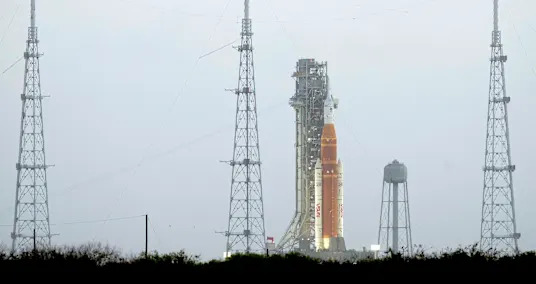
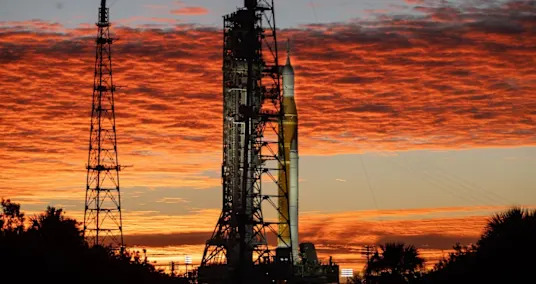
NASA's first human moon mission in 50-plus years is ready for liftoff, and you can watch it leave Earth live.
Artemis 2 will launch four astronauts for a round-the-moon mission no earlier than April 1 at 6:24 p.m. EDT (2224 GMT). You can watch it live here at Space.com, courtesy of NASA; coverage will begin at 12:50 p.m. EDT (1650 GMT).
The mission will initially rocket to low Earth orbit from NASA's Kennedy Space Center in Florida, carrying NASA's Reid Williams (commander), Victor Glover (pilot) and Christina Koch (mission specialist), along with mission specialist Jeremy Hansen of the Canadian Space Agency (CSA).
If all goes to plan, about 24 hours after launch, the Orion capsule carrying those astronauts will conduct a crucial "trans-lunar injection" burn, which will send them to the moon — a realm no humans have visited since 1972.
Artemis 2 will serve as the first crewed checkout of the Space Launch System rocket (which flew once before with the uncrewed Artemis 1, in 2022) and the Orion spacecraft (which also flew uncrewed twice: to Earth orbit aboard a United Launch Alliance Delta IV rocket in 2014 and to lunar orbit on Artemis 1).
Both NASA and the CSA have said they plan to have a multimedia experience following the astronauts. Exterior cameras from Orion will aim to send back live footage 24/7 for much of the mission, although the image may be slightly degraded, depending on distance and data traffic.
Additionally, the astronauts should publicly be in contact with Earth about once a day or so. Exact timing on news conferences and other events hasn't yet been confirmed, as that will depend on how the mission is going. We will carry these events live on Space.com as they happen.
The highlight of the mission will likely be the few-hour period when Artemis 2 flies around the back side of the moon, at a distance as close as 5,000 miles (8,000 kilometers). The moon will be roughly the size of a basketball in the view of the astronauts, who will examine its surface for color, lighting, rock types and other features.

The astronauts also aim to do science on themselves en route, to see how their bodies behave in microgravity while operating in a higher-radiation environment than the International Space Station. And speaking of the ISS: There may even be a ship-to-ship call between the station and Artemis 2's Orion, which Space.com will also carry if and when the event takes place.
Following a roughly 10-day journey, Artemis 2 aims to splash down off the coast of San Diego. NASA has not yet released the timing of this event and the subsequent recovery of Orion, which will be conducted alongside the U.S. Navy, but live video is expected to be available from NASA.
All mission events are subject to change, to an even greater extent than ISS missions, because Artemis 2 is developing procedures and systems for the wider Artemis program. Space.com's Artemis 2 live blog will provide constant coverage of mission events as they happen, so that you can stay up to date that way as well.
LATEST POSTS
- 1
 UPM Adhesive Materials plans new facility near New Delhi, India
 - 2December's overlooked meteor shower peaks next week — will the Ursids surprise us?
- 3ISS astronaut evacuation shouldn't interfere with upcoming Artemis 2 moon mission, NASA chief says
- 4Figure out How to Amplify Innovation and Infotainment Frameworks for Senior Drivers in SUVs
- 5Astonishing Deserts All over The Planet You Really want To Visit



- 'Fertiliser costs mean I'm better off not planting'
- Vote In favor of Your Favored Cereal
- Gaza Strip sees flooding after heavy rainfall
- This Week In Space podcast: Episode 203 — China Rising
- Russian authorities threaten WhatsApp with total ban
- NASA begins fueling rocket to launch astronauts on the first lunar trip in half a century
- Russia Creates New Military Branch Dedicated To Drone Warfare
- East Germany Somehow Built a Real Sports Car and It Was Wild
- Influencers are selling a delusional fantasy of being postpartum. Why is it so easy to believe?